
APPLICATIONS / MORBIDOSTAT
What is a Morbidostat?
A morbidostat is a continuous culture system designed to force the microbial culture to evolve resistance to a selective agent (usually an antibiotic) by periodically diluting the culture using either a bacterial growth medium or an antibiotic-supplemented medium.
The proportion of the antibiotic in the feed is regulated so that the culture is constantly being challenged without killing it.
This is achieved through real-time optical density (OD) measurement and automated feedback control.

Why use a Morbidostat?
A morbidostat enables the culture to rapidly evolve resistance to a selective agent. This is useful in directed evolution experiments, in which a desired goal (e.g., an increased production rate of an enzyme or a product) can be coupled to an increases resistance to an antibiotic.
Rapid acquisition of de novo resistance to drugs is also an interesting problem on its own, and is being researched as part of global efforts to tackle antimicrobial resistance (AMR).
The morbidostat essentially emulates the serial dilution and selection protocol used by researchers in these fields. Typically, a number of cultures would be started in shaken flasks or microtiter plates and, after a period of growth, serially diluted into media containing increasing concentrations of an antibiotic. The cultures would then be screened and the process would be repeated for the ones that adapted to the antibiotic.
Ogi3 implements this process in only 15 mL culture volumes in a fully automated way, enabling the researcher to focus on the interpretation of the results rather than the laborious process of manual dilution.
How does a morbidostat work?

Ogi3’s implementation of the morbidostat differs slightly from the original morbidostat paper (E. Toprak et al., Nat. Gen. 44, 101–105 (2012)).
Each Ogi3 flask is connected to three flasks: a waste bottle (similar to the turbidostat setup) and two reservoir bottles via a Y junction: one for plain medium, and another one with the medium containing an antibiotic (AB) or another selective agents. For brevity, we will refer to this bottle as the “AB” bottle.
Dilution occurs in discrete cycles of fixed length of time (e.g., every 30 min). At the end of each dilution cycle, the morbidostat algorithm compares the OD with a set OD threshold. If the OD is higher than the threshold (bacteria have adapted to the last concentration of the AB), the culture is diluted with AB. Otherwise, the culture is diluted with plain medium.
Dilution replaces a fixed fraction of culture’s volume (“dilution factor”) with fresh media. This is implemented by running the corresponding media inlet pump for a specific period of time, calculated from the dilution factor and the pump flow rate.
It is important to note that in the Ogi3 morbidostat mode, the “Input” pumps are used as the antibiotic inlet pumps, while the “Output” pumps are repurposed as plain media inlet pumps. To remove the excess (“waste”), a dedicated outlet pump is therefore required. This pump must run continuously and independently of the inlet pumps. Since this pump does not need to communicate with Ogi3, any external pump can be used as long as it can pump out at least several ml per minute of waste culture. In case the user does not have a suitable pump, Ogibiotec can provide such a pump or recommend what 3rd party pumps to purchase.
Expected behaviour

The plot above shows the results of an experiment in which an antibiotic-sensitive laboratory strain of E. coli evolved resistance to ciprofloxacin (CIP). Optical density (OD) was measured continuously during the experiment, whereas CIP concentration is a prediction (not a measurement) based on the injected volumes of media and CIP. Threshold OD above which the antibiotic is injected was set to 0.3. The morbidostat initially injected a high dose of CIP (t≈0.5 h). The culture responded by reducing its growth rate to the point when it could not keep up with dilutions (t<10 h). The morbidostat then switched to injecting plain media. The culture quickly recovered, but when the morbidostat injected more CIP (t≈15h), the culture responded much less because a resistant mutant had already taken over. The morbidostat then further increased CIP concentration, facilitating a stronger response (t>25 h).

The morbidostat experiment can run for hundreds of hours as illustrated by the above plot. The experiment is also insensitive to perturbations such as the media running out and biofilm formation, which plague long-term evolutionary experiments. In the above experiment, resistance to CIP increased by 4 orders of magnitude (from about 10 ng/ml to tens of ug/ml) in 3 weeks.
Want to find out how you could use a morbidostat?
What else can an Ogi3 do?
Bang-Bang Turbidostat
Automate the process of generating growth curves by repeatedly growing cells across a defined portion of their growth curve under repeated or varied conditions.
Turbidostat
Hold your culture at the required point in their growth for your experiments with high frequency OD measurement and automated dilution.
Chemostat
Provide a consistent growth environment for your cells by continuously feeding them with fresh culture media.
Batch Culture
Automate the experiments you’re doing in shake flasks with the added real time analytics and control you need to get robust datasets with minimal hands-on time to maximise your productivity.
Build the perfect OGI3 for your experiments
OGI3 Bioreactor
Four independent bioreactors with precise control over stir speed, temperature, and optical density measurements.
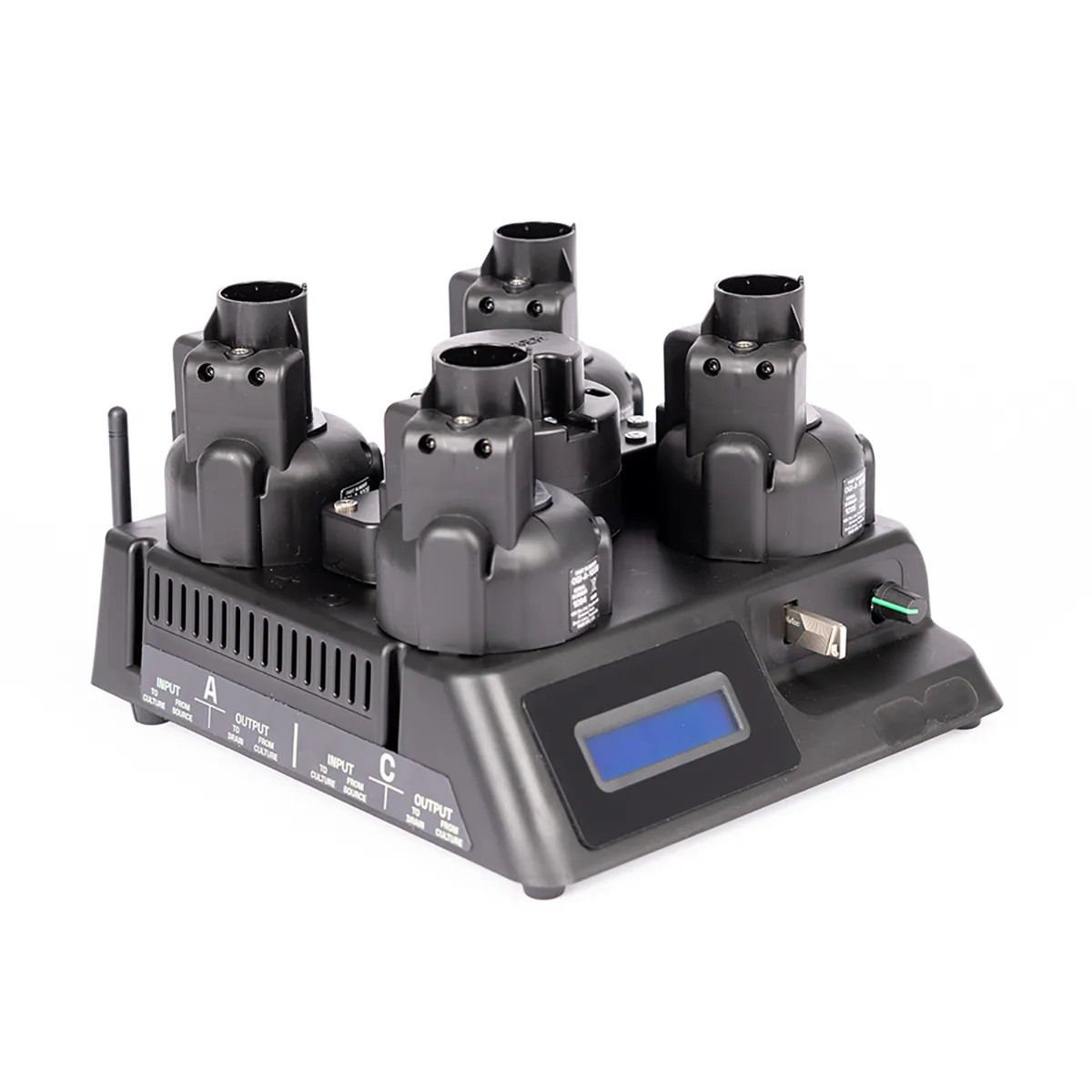
Liquid Control Module
Effortlessly manage your liquid cultures with ogibiotec’s liquid control module.

Fluorescence Module
Enables real-time full spectrum scan of 340 to 780 nm in 2 nm increments.

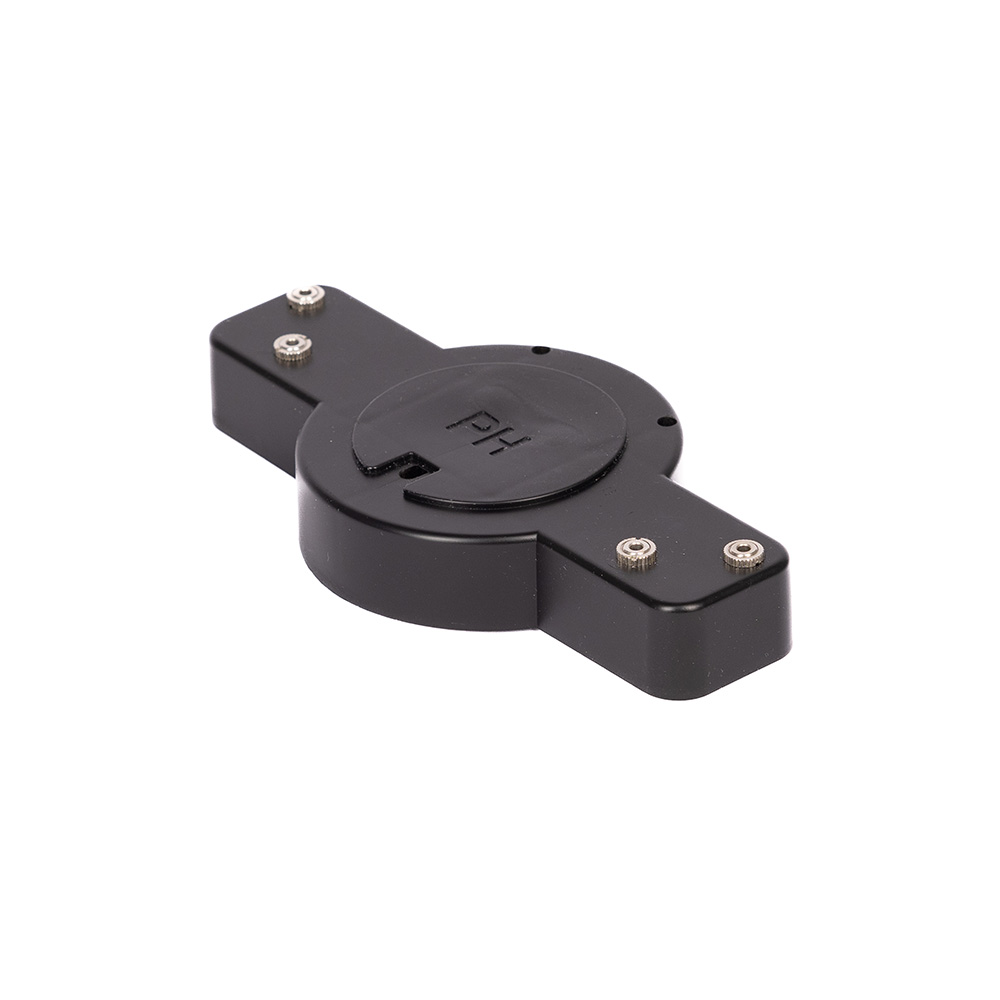
pH Module
Monitor the pH in each culture. Ogi3 pH probes to allow the accurate measurement of pH 0-14.
Dissolved Oxygen Module
Measure the concentration of Oxygen in your cultures in real time.

Sparging Module
Provide additional gas to your cultures via headspace or dip-tube sparging. Supplied with pre-humidification units.
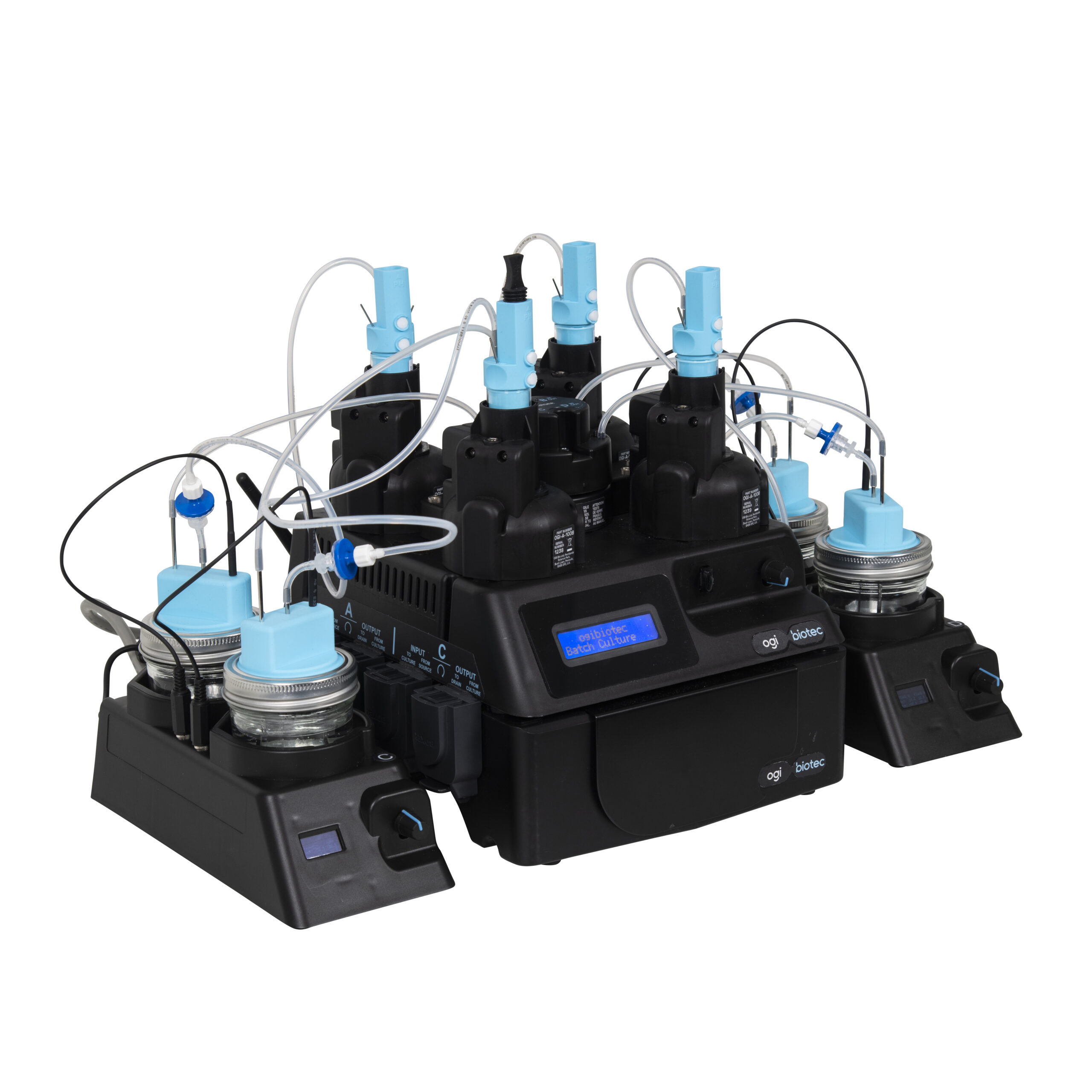
NB: Images not to scale